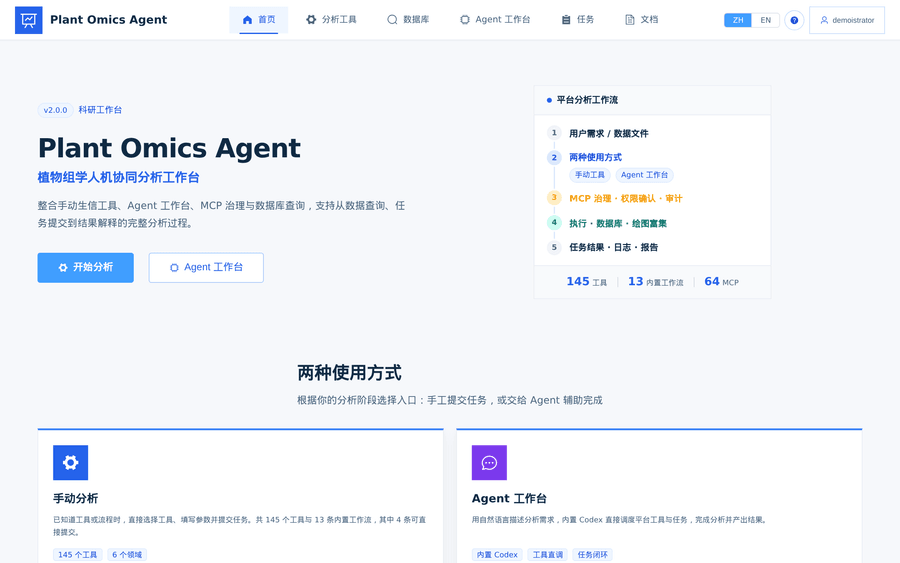
Pick a tool, fill parameters, and submit tasks directly from the web UI. Verified native workflows (RNA-seq / ATAC-seq / ChIP-seq / scRNA-seq) submit directly as task chains, GWAS has a dedicated one-page frontend form, and the rest are routed to the Agent Workbench.
A human-agent collaborative platform for
plant omics analysis
Manual web tools and the agent workbench share one set of tools, tasks, and result management; the agent calls platform capabilities under tiered permissions, write confirmation, and audit, organizing supported analysis steps as needed — assisting analysis, never executing freely. * Figures are a static catalog count as of 2026-10-16, not a count of successful runs.
Manual submission and agent assistance — one shared platform
One tool catalog, task system, and result store backs both paths: manual submission for analyses with clear targets, agent assistance for natural-language exploration and interpretation; RStudio is an optional, standalone R execution stack for interactive R analysis.
Work in natural language in the Agent Workbench. The agent organizes analyses via skill guidance and capability routing: it first matches a relevant skill (9 platform skills), then routes through four capability classes (execute directly / adapt then execute / needs more input / needs agent exploration) before a governed submission; read/write tiering, write confirmation, and full audit constrain every call.
Filling the gap between web platforms and general agents
Web platforms moved tools into the browser but lack context-aware agent collaboration; general LLM agents are flexible but lack structured, auditable access to domain tools and biological data. Plant Omics Agent unifies the two.
Command-line barrier
Traditional web platforms lack context-aware collaboration
General agents can't reach domain tools
General-purpose LLM agents lack structured, auditable access to domain tools and biological data
Unsupervised execution
Arbitrary scripts run without oversight
Scattered databases
Plant omics databases and regulatory resources are everywhere
Lost provenance
No way to know which parameters produced an output
Key difference: one shared tool ecosystem, task system, and result store — usable manually, or by agents under tiered permissions and audit.
Two layers: the agent orchestrates an analysis, the platform executes it under governance
The upper layer is orchestration — how the agent organizes an analysis: skill guidance plus capability routing. The lower layer is governance — how execution is constrained: read/write tiering, write confirmation, result pagination, and full audit.
Orchestrate · Researcher asks a plant question
Ask a plant omics question in natural language in the Agent Workbench; the session is bound to user / project / session.
Orchestrate · Match a relevant skill
9 platform skills (batch RNA-seq, RStudio runtime, paper writing, etc.) provide method guidance for the task.
Orchestrate · Capability routing, four classes
The capability catalog decides: execute directly / adapt then execute / needs more input / needs agent exploration.
Orchestrate · Submission eligibility + live schema
Eligibility is checked before submission; the live tool schema is fetched and inputs are validated.
Orchestrate · Governed execution, real outputs
Real platform tools are invoked; the agent reads real outputs rather than paraphrasing.
Orchestrate · Continue or hand back
Continue to the next step, verify evidence, or hand the key decision back to the researcher.
Govern · Session and permission context
The backend writes MCP config dynamically per agent project, binding permission scope and write-confirmation state.
Govern · Tool visibility by scope
Read-only sessions can only access L1 read tools; subagent profiles further restrict the tool set.
Govern · Schema validation + confirmation
Inputs are schema-validated; write / workspace file operations follow session scope gates.
Govern · Result Store pagination
Large results are paginated via the Result Store to avoid context overflow.
Govern · Full audit
Every tool call enters MCP audit — with user, scope, confirmation state, and audit metadata.
Govern · Traceable replay
Task logs, parameter snapshots, and artifact manifests are retained — any analysis can be revisited and reproduced.
Governance: read/write tiering
Tool schemas, database search, gene ID mapping, motif-to-TF, task logs, result manifests
No confirmationSubmit action / native workflow, enrichment & plotting batch
ConfirmationFile access constrained to the configured workspace
Session scopeTwo MCP channels: compat (/api/mcp/*) and official (/api/mcp-official/*); static expansion counts 56 tools (48 read, 7 write, 1 file); runtime visibility adapts to session permissions.
Two paths, four real scenarios
From manually submitting tool tasks and native workflows, to agent-assisted evidence integration and one-page GWAS submission.
Database evidence integration
Given a candidate gene / DEG / motif table, query MaizeGDB / UniProt / KEGG / JASPAR / PlantRegMap via MCP, run gene ID mapping and motif-to-TF mapping, and consolidate everything into one evidence table — fully audited.
- Query multiple databases via unified MCP tools
- Gene ID mapping + motif-to-TF (CIS-BP 3.10 / JASPAR 2026 supply chain)
- Every call enters the audit log
Natural-language exploratory analysis
Ask in the Agent Workbench: the agent discovers tools via skill matching and capability routing, searches databases and workspace files, submits governed actions after confirmation, and interprets the real outputs.
- Platform context and data awareness
- Write operations pass confirmation gates
- Large results paginated via the Result Store
RNA-seq native workflow direct submission
Fill in sample metadata and reads in a form, then submit the task chain directly (QC → trim → align → quantify → DE → enrichment) and track progress in the task list; the run ends with a self-contained HTML report (layered writing model + hedging guard, claim strength aligned with evidence) and a project delivery ZIP.
- Verified workflows submit as task chains in one click
- Task status / logs / outputs fully visible
- Self-contained HTML report + project delivery ZIP
Genome-wide association analysis (GWAS)
One dedicated frontend form: genotype as a single VCF or PLINK BED triplet + a phenotype table, reference version B73 v4 / v5 / Others, with an intent review before submission. Five models in one submission: GEMMA (LMM / LM) + rMVP (GLM / MLM / FarmCPU); QC + kinship matrix + PCA with tiered significance thresholds (strict to relaxed); SnpEff effect annotation (B73 v5 default, v3 explicit opt-in); CMplot publication-grade Manhattan / QQ / density plots; same-build local gene annotation + optional GO/KEGG enrichment (B73v4 / v5 dual backgrounds); a self-contained HTML summary report + project delivery ZIP.
- Dual-exit exploration: B1 read-only profiling / B2 bounded auto-exploration (preset budget caps; results carry honest calibration labels — uncalibrated results are not claimed as findings)
- Posthoc exploration: submit existing GWAS association results directly for tiered exploration
- Two real-data end-to-end runs: whole-genome rerun in ~88 minutes; all five models completed, 2,421,381 valid P rows per model, delivery of 234 files (~458 MB)
Four layers: from entry points to governed execution
Each layer has clear responsibilities and boundaries; the manual and agent paths share the same capabilities.
Grounding analysis and agents in biological evidence
19 plant-relevant public databases and regulatory resources, exposed to agents and manual users via unified MCP tools, plus a natural-language database query entry. Maize TF and motif evidence is backed by a versioned resource supply chain: the GRASSIUS 2.0 master list, iTAK v2, the CIS-BP 3.10 motif library, JASPAR 2026, PlantPAN 5.0, plus published evidence sets such as Huo2025 mGRN and Galli2025 DAP. The resource catalog is version-managed and retires what breaks: since 2026-09, 5 upstream-dead databases have been retired and PlantPAN upgraded to 5.0 with real form-based queries.
General reference & sequences
Transcription factors & cis-regulation
Regulatory evidence & public data
Maize-specific
search_bio_database(s)gene_alias_resolvergene_id_mappertf_target_evidence_aggregationmotif_to_tf_mappingliterature_relation_extractionMaizeGDB ID / version / annotationOne tool ecosystem covering mainstream plant omics
From sequencing data to regulatory networks, evolution, epigenomics, GWAS and visualization — what matters is these capabilities are shared across both the manual and agent paths, not just the counts.
RNA-seq
StableFastQC/MultiQC, Trimmomatic/fastp, HISAT2/STAR, featureCounts/StringTie, Salmon/Kallisto, DESeq2, GO/KEGG, GSVA/fgsea
ATAC-seq
StableFastQC, Trimmomatic, Bowtie2, SAMtools, MACS3, HOMER motif, TOBIAS, IDR, deepTools
ChIP / DAP-seq / Cut&Tag
ExtendedBowtie2, MACS3, deepTools
Single-cell
ExtendedCell Ranger, Scanpy, scVelo, CellChat
Enrichment & visualization
Stable33 scientific plot templates (19 Python + 14 R) · maize GO/KEGG batch enrichment (B73v4 / v5 dual backgrounds) · eggNOG v5.0.2 built-in annotation library · GSVA / fgsea
Regulatory networks
ExtendedWGCNA, GENIE3, GRNBoost2, SCENIC/SCENIC+, ATAC2GRN
Evolution & synteny
ExtendedMAFFT, IQ-TREE, OrthoFinder, MCScanX, WGDI, MUMmer4, SyRI
Epigenomics & 3D
ExtendedBismark, methylKit, HiC-Pro, ChIA-PET2
GWAS & genetics
StableGEMMA (LMM / LM) + rMVP (GLM / MLM / FarmCPU), five models in one submission · QC + kinship matrix + PCA · tiered significance thresholds (strict to relaxed) · SnpEff effect annotation (B73 v5 default, v3 explicit opt-in) · CMplot publication-grade Manhattan / QQ / density plots · local annotation + optional enrichment · HTML report + delivery ZIP · posthoc tiered exploration
Three-tier capability maturity
Each area is rated as it stands: MCP governance and controlled execution are the core mechanism; the RNA-seq / ATAC-seq / ChIP-seq / scRNA-seq native workflows submit directly from the frontend, and GWAS has a dedicated one-page form plus posthoc; extended pipelines such as synteny route through the agent and remain preliminary. Ratings reflect catalog and run-verification status, not scientific conclusions.
Modern, portable, containerized
Frontend/backend split, one-command Docker deployment, with local development and RStudio interactive analysis (optional standalone).
Want the details? Open the guide
The landing page only gives the overview. Deployment, both usage paths in full, MCP governance, and database queries all live in the guide.
Start with manual submission or agent assistance
Open the platform now: submit a tool task, start a one-page GWAS submission, or begin an analysis with one sentence in the Agent Workbench.
Both entries point to the same Plant Omics Agent platform; choose by network.