Databases & regulatory resources
Plant omics databases and regulatory resources are a signature feature that sets Plant Omics Agent apart from generic Agent platforms: 19 public databases are exposed through unified tools to manual users and the Agent alike, and query results can be retained as query records or file artifacts for downstream analyses to reference.
The 19 public databases
General reference & sequences
| Database | Typical use |
|---|---|
| UniProt | Protein functional annotation |
| NCBI (PubMed / Gene / Protein / BLAST) | Sequence and literature search |
| KEGG | Pathways and metabolism |
| Ensembl (incl. the Ensembl Plants workbench) | Genome annotation and IDs |
| AlphaFold DB | Protein structure prediction |
Transcription factors & cis-regulation
| Database | Typical use |
|---|---|
| JASPAR (2026) | TF binding motifs |
| PlantPAN 5.0 | Plant promoters and cis-elements |
| PlantTFDB | Plant TF family annotation (legacy, local maize) |
| PlantRegMap | Plant regulatory mapping |
Regulatory evidence & public data
| Database | Typical use |
|---|---|
| ChIP-Hub | ChIP-seq regulatory evidence |
| Expression Atlas | Expression maps and sample metadata |
| PTMSite | Maize phosphorylation site evidence |
| Public RNA/ATAC/ChIP-seq catalog | ENA retrieval + local wide cache, run-level access to public data |
Maize-specific
| Database | Typical use |
|---|---|
| MaizeGDB | Maize gene, version, and annotation queries |
The maize TF/motif evidence supply chain
Maize transcription factor and motif evidence is backed by a versioned supply chain: GRASSIUS 2.0 as the master list, iTAK v2, CIS-BP 3.10 motifs, JASPAR 2026, PlantPAN 5.0, the Huo2025 mGRN, and Galli2025 DAP. The motif→TF mapping behind tools like motif_to_tf_mapping now walks the materialized CIS-BP 3.10 and JASPAR 2026 matrices.
Retirement governance
The resource catalog is version-managed: when an upstream service fails, the entry is retired. In 2026-09 five databases were retired (KnockTF / ATTED-II / MaizeNetome / RiceENCODE / Wheat-RegNet — upstream services no longer maintained), and PlantPAN was upgraded to 5.0 with live queries.
Three ways to query
Option 1: natural-language database query on the Databases page
Open the platform’s Databases page and describe the query in plain language, for example:
“Look up the JASPAR motifs that bind maize Zm00001d000001’s promoter and its gene annotation in MaizeGDB.”
The platform parses your description and searches across databases, returning structured results — no need to learn each database’s own search interface first.
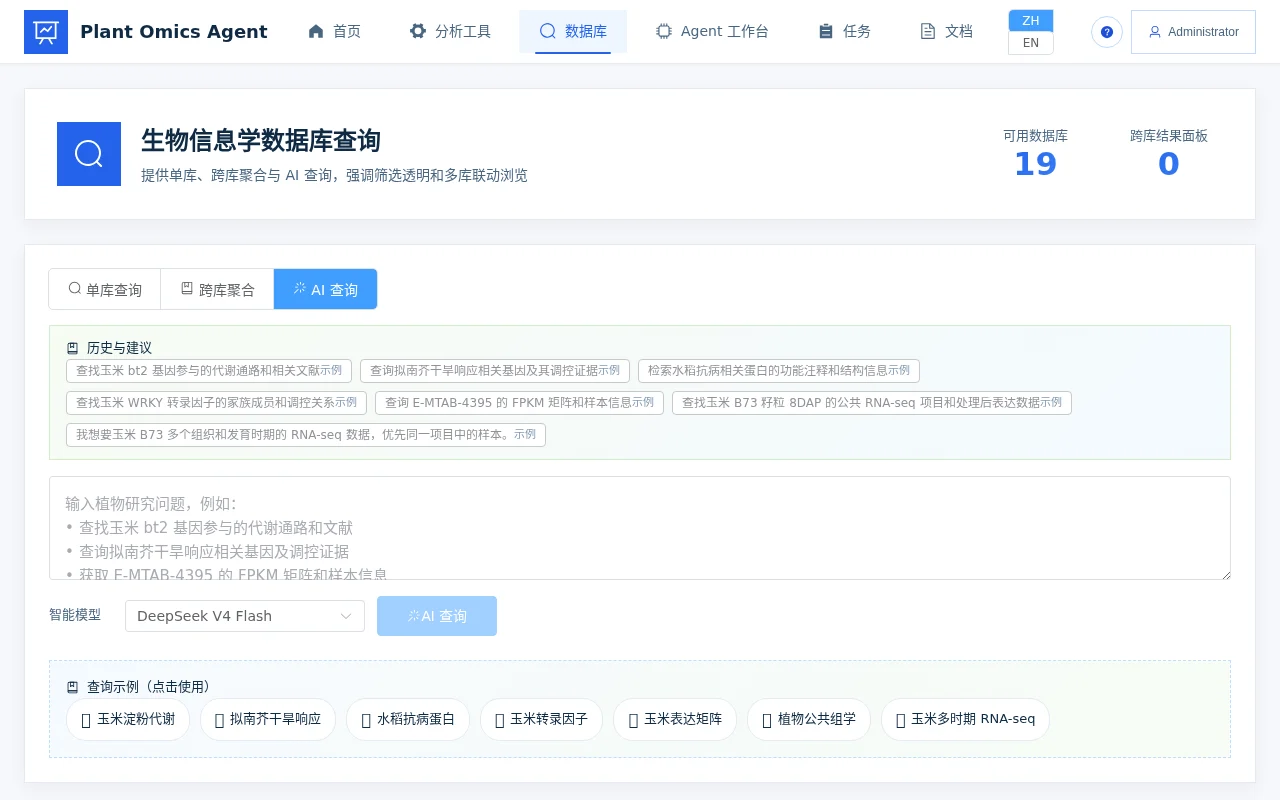
Option 2: ask the Agent
Query databases conversationally in the Agent Workbench. The Agent calls read-only tools (L1, no confirmation) such as search_bio_database(s), gene_id_mapper, and motif_to_tf_mapping, and consolidates results from multiple sources into a single evidence table; motif→TF mapping walks CIS-BP 3.10 / JASPAR 2026.
Option 3: query via tool forms
Some database queries are also wrapped as query tools in the tool catalog — fill the parameters and submit like any other tool, ideal for bulk, reproducible queries.
Query results and record retention
Query results aren’t just for looking at:
- Results can be saved as query records or file artifacts;
- Saved results appear in the workspace or task-artifact list and can be referenced as file inputs by later tasks;
- Records retain the source database and query context, keeping downstream evidence traceable.
This closes the loop from “query evidence” to “run analysis”: for example, a retrieved target-gene list can feed straight into an enrichment tool.
A closed-loop query example
Given a candidate-gene table
  → parse the table and unify IDs (gene_id_mapper)
  → query JASPAR 2026 / PlantRegMap / MaizeGDB
  → motif_to_tf_mapping links motifs to TFs (CIS-BP / JASPAR 2026)
  → aggregate into a candidate TF evidence table
  → save it as a query record or file artifact for downstream tasks
See the candidate-gene evidence integration case under Use cases.
[Screenshot coming: the query-result and task-artifact record UI]
* Static catalog count as of 2026-10-16, not successful-run count.